


Titanium Jewelry FAQs
Titanium Jewelry - Rings, Bracelets, Necklaces & More!
1. What color is titanium?
Titanium is a lightweight, strong
metal that ranges from a light gray to a soft silver. Polished titanium sits
close to platinum, just a shade or two darker. A brushed finish deepens that
tone slightly, and a sandblasted finish reads closer to gunmetal, almost a true
gunmetal gray.
2. Does titanium come in different colors?
Titanium is a reactive metal, which means it can be anodized into color through
electrolysis or heat treatment — but the effect isn't permanent. An
anodized ring looks good at first, then scratches and discolors as you start
wearing it. We work only with natural-color titanium and do not offer
anodizing.
3. Do you offer black titanium?
We don't work with black titanium. The clearest flaw is that the color
isn't solid: black titanium rings are made from a special grade that
produces a thin black deposit on the surface when heat-treated. That deposit
is tough and somewhat scratch-resistant, but still thin, and it will scratch
off over time, showing white marks underneath.
Black ceramic is the alternative we recommend — a space-age material as light as titanium and as tough as tungsten carbide. Black zirconium ceramic has a metallic appearance and a solid black color that doesn't rely on a surface coating. See our collection of black ceramic and black tungsten rings.
4. What grade of titanium do you use?
Our rings are available in aircraft-grade Ti-6/4, extra-hard
Ti-6/6/2, and commercially pure Ti-999. Each grade is fully
hypoallergenic; the difference between them is hardness and how
the ring wears over time. Learn more on our
titanium
grades page.
5. What finishes do you offer?
Every ring is available in polished, brushed, hammered, or
sandblasted finish, so you can match the look to how you want
the piece to wear day to day. Each finish changes both the color
depth and how the ring catches light — see question 14
below for more detail on each.
6. Do your rings come with a comfort fit?
Yes — every ring we make includes the Comfort Fit feature,
which rounds the inside edge of the band against the skin so it
sits more naturally on the finger. See our
ring
size guide for more on how comfort fit and sizing work
together.
7. Is a titanium ring scratch-proof?
No ring is scratch-proof, and titanium is no exception —
but it is scratch-resistant. On our hardest grade, Ti-6/6/2,
scratches stay shallow, just barely on the surface, and buff out
easily, while gold and platinum rings scratch much deeper.
Titanium also resists deformation, nicks, and dents, and the
ring keeps its original form and design for life, even after
multiple re-finishings.
Every ring we sell includes free
re-polishing twice a year for as long as you own it — see
our lifetime
refinishing policy for full details on how to send it
back.
8. Can a titanium ring be removed in an emergency?
Yes. Visit our titanium
ring emergency removal page for step-by-step guidance, or
see our ring
cutter page for the Power Ring Cutting Kit, built to cut
through titanium, stainless steel, cobalt, and other hard
metals.
9. How do I clean titanium jewelry?
Soak the piece in warm water with a gentle soap, such as baby
soap or dish soap, for a few minutes, then scrub lightly with a
soft brush. Prepackaged jewelry-cleaning solutions work well
too. Rinse and dry with a microfiber cloth.
Between
cleanings, a jewelry-polishing cloth removes everyday residue
and water spots.
10. How are titanium, tungsten,
and stainless steel different?
Stainless Steel - Stainless steel is
the most affordable of the three, used widely for wedding bands,
but it's more prone to scratches and may need replacing
depending on care and use.
Titanium -
Titanium is lightweight, stylish, and long-lasting — more
scratch-resistant than stainless steel, which is part of why it
costs more, and also more crack-resistant, and most titanium
rings are hypoallergenic, which makes them a strong choice for
sensitive skin.
Tungsten -
Tungsten is the heaviest of the three, giving it the strongest
lifetime durability, and holds its shape forever — it's
about four times harder than titanium, and typically the most
expensive of the three. See our tungsten
rings warranty and sizing guide for more on tungsten specifically, including our
cobalt-free carbide and lifetime sizing guarantee.
11. How long will titanium jewelry last?
Titanium rings are roughly seven times stronger than the
traditional white metals used in wedding bands or engagement
rings. With occasional cleaning, polishing, and care taken
during extreme situations, a titanium ring is built to last a
lifetime — it will never rust and resists fading.
12. Are titanium rings hypoallergenic?
Yes. Titanium
is nickel-free, and nickel is the most common source of
metal-related skin irritation, so titanium jewelry has become a
dependable choice for anyone with sensitive skin or a diagnosed
nickel allergy — most grades won't irritate or
discolor skin during wear. See our nickel-free
titanium rings page for more detail.
13. What types of jewelry
come in titanium?
Titanium is used across a wide
range of jewelry, including engagement rings, wedding bands,
necklaces, chains, crosses, pendants, earrings, and bracelets
— so the same durable, hypoallergenic material can carry
through everything you wear.
14. Which titanium
ring finish is best for me?
It depends on the look
you want and how hard the ring will work day to day. Polished is
the brightest option, sitting close to platinum in color, but it
shows everyday scuffs sooner than the others. Brushed has a soft
satin texture that deepens the tone slightly and helps hide
light scratches. Hammered adds a textured surface that catches
light from many angles and naturally disguises wear. Sandblasted
is matte and reads closer to gunmetal gray for a more
understated look. If you work with your hands, a brushed,
hammered, or sandblasted finish will hold its look longer
between refinishings; if shine matters most, polished is the
classic choice. Whichever you pick, our lifetime
refinishing policy keeps it looking fresh.
15.
Can a titanium ring be resized?
We don't offer
resizing on titanium rings — every ring is made to order,
so getting your size right before production begins is what
matters. That's why we send a free Perfect Fit Every
Time™ sizing set with every order. If you skip the sizing
set and the ring doesn't fit, you can still return or
exchange it within our
14-day
money-back guarantee, but a
restocking fee applies since the ring was made to order without
confirming your size first — the exact percentage depends
on the order, so check our return policy for
specifics. Using the sizing set avoids that fee
entirely. See our
ring
size guide for how to measure at home.
16.
Can I shower or swim while wearing my titanium ring?
Yes. Titanium doesn't react with water, chlorine, or soap,
so it's safe to wear in the shower, the pool, or the ocean
without any risk of tarnishing or damage.
17.
Will a titanium ring turn my finger green?
No.
Titanium doesn't oxidize or react with skin the way some
base metals do, so it won't leave the green or black residue
that copper-alloy jewelry sometimes causes.
18.
What are the downsides of a titanium ring?
The main
tradeoff is sizing: titanium is harder to resize than gold or
platinum, which is why we recommend using our free sizing set to
get your size right before production. In exchange, titanium
won't tarnish, corrode, or cause the allergic reactions that
some traditional metals can, and it holds its shape and finish
for a lifetime with normal wear.
19. How long does
it take to receive my titanium ring?
Every titanium
ring is handcrafted after we receive your order — we
don't stock finished rings, which is what lets us offer a
choice of grade, width, finish, and inlay. Standard production
takes about 7–10 days from when we confirm your finger
size (allow 3–6 days for the free sizing set to arrive by
mail first), or 7–10 days from your order date if you skip
the sizing set. Rings with stone or platinum inlays may take
1–2 days longer. Need it faster? Rush Order Service ($45)
cuts production to 1–3 days with expedited sizing-set
delivery and same-day shipping once the ring is made. See our
full
production and shipping details for chains, bracelets,
earrings, crosses, and tungsten/ceramic rings, which all ship
much faster since they're pre-manufactured.
20.
I have larger knuckles and rings feel too loose once they're
past it — what do you suggest?
A wider band
typically sits better over a larger knuckle. At no additional
charge, we can also add a tightening rod to the inside of the
band to take up excess room on the finger — just note this
in the comments box when you order, or mention it when
confirming your size. See our
ring
size guide for more on getting the fit right.
21.
What do ring width and ring thickness actually mean?
Width is how much of your finger the ring covers, from the base
toward the knuckle — wider bands make more of a style
statement, narrower ones sit closer to the finger. Thickness is
how substantial the band feels from the inside to the outside
edge; our standard thickness is 1.8mm–2.3mm, with thinner
(1.4mm–1.9mm) and thicker (2.2mm–2.5mm) options
available on request. See our
ring
size guide for the full breakdown and printable width
chart.
22. Can a titanium ring be
engraved?
Yes. Every ring can be engraved on the
inside in your choice of block or italic capital letters,
fitting roughly 28–30 characters including spaces. See our
engraving
details for font samples and pricing. Note: engraved
titanium rings carry a $20 refurbishing fee if returned or
exchanged.
23. Will a titanium ring set off a
metal detector or airport security?
Generally, no.
Titanium is non-ferromagnetic, so standard metal detectors and
TSA checkpoints typically don't flag it the way they would
iron- or nickel-based alloys. That said, a ring with certain
inlays (like steel-based accents) could behave differently, so
if you're wearing an inlaid design through security, it's
worth knowing what the inlay metal is.
24. Is
titanium a good choice compared to gold or platinum for a
wedding ring?
It depends on what you're
prioritizing. Titanium is far more scratch-resistant and durable
than gold or platinum, significantly lighter, and typically much
less expensive — but it can't be resized the way gold
or platinum can, and it doesn't carry the same traditional
prestige some couples want in a wedding band. If durability and
comfort for daily wear matter most, titanium is the stronger
choice; if resizing flexibility or the classic look of a
precious metal matters more, gold or platinum may suit you
better.


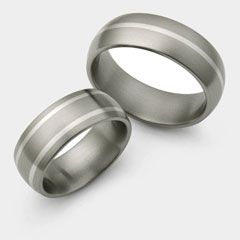
Titanium Style is an online Titanium Rings store. We specialize in custom titanium ring design, inlaid titanium rings, black ceramic rings, titanium wedding bands, chains, necklaces, bracelets, tungsten rings, and more.
1-513-520-0527
sales@titaniumstyle.com


Copyright © 1998-2026 Avant-Garde Jewelry Co, Inc. All rights reserved. | Privacy & Security