

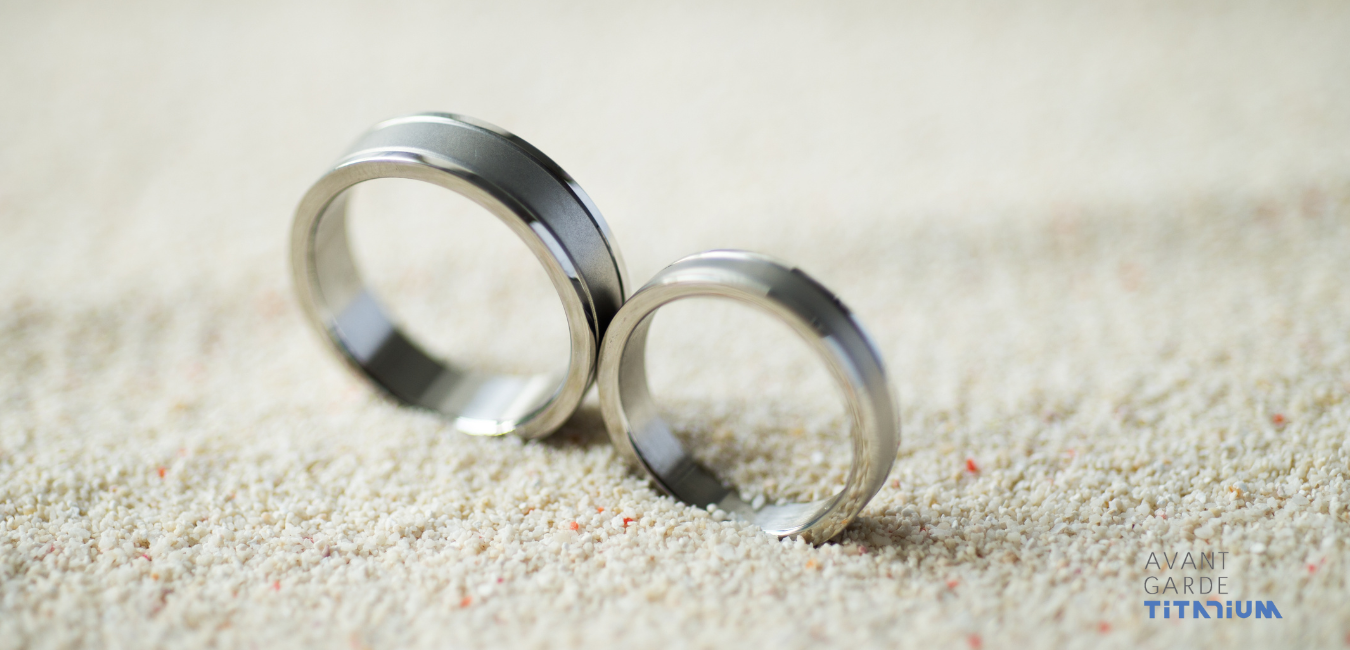
You’ve chosen a titanium ring. Then the catalog asks one more question: which grade?
At first glance, the answer can sound like spec-sheet jargon. Ti-999. Ti-6/4. Ti-6/6/2. But those codes do mean something for the ring on your finger, from how it feels and wears to why one option may cost more than another.
The titanium grades we use at Avant-Garde Titanium Style share the same base element, but they are built for different purposes. The right grade depends less on which name sounds the most impressive and more on how you plan to wear the ring. Here is what each grade offers, how they differ, and which one may fit you best.
The Three Titanium Grades at a Glance
Every titanium ring we make begins with one of three titanium ring grades: commercially pure, aircraft-grade, or extra-hard. The base element is the same in all three. What a small measure of aluminum, vanadium, or tin adds is where the titanium grades diverge.
The table below is the quick read. The sections after go deeper into what each grade feels like and who it suits.
| Grade | Composition | Strength Profile | Best For |
|---|---|---|---|
| Commercially Pure (Ti-999) | 99.9% titanium, no alloy | Softest in the range; most pliable | Elemental preference, lightest feel, minimalist look |
| Aircraft-Grade (Ti-6/4) | 90% Ti, 6% Al, 4% V | Up to 150 ksi tensile; Brinell 330; ~3× stronger than CP | Active everyday wear, corrosion resistance, balanced comfort |
| Extra-Hard (Ti-6/6/2) | 86% Ti, 6% Al, 6% V, 2% Sn | Up to 180 ksi tensile; Brinell 389; highest dent and scratch resistance | Hands-on work, tension-set engagement rings, heaviest daily wear |
Commercially Pure Titanium (Ti-999)
Commercially pure titanium, or CP, is titanium at its most elemental. 99.9% of the ring is the single element itself, with no aluminum, no vanadium, no alloying metal at all.
That purity has a certain appeal. CP reads a little warmer on the hand, a little quieter in tone, and it is the lightest of our three grades. It is also the easiest to form in the shop.
The trade-off with CP is durability. Compared with gold or sterling silver, CP is still the harder metal; compared with the alloys that follow, it is the most giving of our titanium grades. CP is more pliable, holds less spring, and shows the small marks of daily wear a little earlier. For some wearers that patina is welcome. For others it reads as wear.
All three of our titanium grades are fully hypoallergenic, so sensitivity is not the reason to choose CP over the alloys. CP’s place is for the wearer who prefers an unalloyed metal or simply wants the lightest feel on the hand. For most everyday wearers we recommend one of the two grades below.
Aircraft-Grade Titanium (Ti-6/4)
Aircraft-grade titanium is where the alloying work begins. The mix is 90% titanium, 6% aluminum, and 4% vanadium — a three-part recipe designated ASTM B348 Grade 5 and used across the aerospace industry in jet engine components, airframe structures, and spacecraft.
For a ring, what matters is less the aerospace reputation than how the alloy performs on your hand. Aircraft-grade titanium is about three times stronger than commercially pure titanium, with a tensile strength up to 150 ksi (150,000 psi) and a Brinell hardness of 330. Corrosion resistance is excellent. Water, sweat, and salt air do not meaningfully affect the metal. Weight stays low because both aluminum and vanadium are themselves lighter structural metals.
Day to day, that shows up as real scratch resistance across the small knocks of daily life, a finish that holds rather than softens under wear, and a ring that keeps its round profile under pressure.
The honest caveat: aircraft-grade titanium is not scratch-proof. No metal is. A deliberate strike on concrete will leave a mark. Under ordinary wear, though, it holds its own against pure titanium, most golds, and sterling silver. That is why it is the grade most of our customers end up wearing, and the grade most of the titanium rings in our catalog are built from.
Extra-Hard Titanium (Ti-6/6/2)
Extra-hard titanium carries the alloy approach to its furthest point. 86% titanium, 6% aluminum, 6% vanadium, and 2% tin. The extra vanadium and the tin push both hardness and tensile strength past the aircraft-grade range, with tensile strength up to 180 ksi (180,000 psi) and a Brinell hardness of 389 — the highest in our range.
Ti-6/6/2 is the most resilient titanium we make. It dents less. It scratches less. It holds its edges cleaner across years of daily wear. It is also the only grade we carry that is hard enough for tension-set engagement rings, the setting style that holds a center stone by spring pressure alone, without prongs. Most metals creep under that kind of continuous load. Ti-6/6/2 does not.
There is one trade-off worth naming. The same hardness that gives Ti-6/6/2 its resilience also makes it difficult to work with. It wears down tools and takes longer to machine and finish. That is why fewer jewelers offer it, and why it costs a little more than the aircraft grade. It is also why the rings we cut from this alloy tend to hold their form and their detail for a lifetime.
How to Choose the Right Titanium Grade
The grade question almost always comes down to how you plan to wear the ring, not which spec sheet reads as the most impressive. Each of the three titanium ring grades we offer has a clear best-use case, and the right match usually follows from how the ring will spend its days.
If your days are spent at a keyboard and you want the lightest possible feel on the hand, commercially pure titanium may be the right fit. It is the lightest of the three and the closest to pure titanium — some wearers simply prefer that on principle.
If you want a ring that holds up under daily wear, stays comfortable all day, and resists corrosion, aircraft-grade titanium is where most of our shoppers land. Of the three titanium grades we carry, it is the one we most often recommend when you’re not yet sure which direction to go.
If you work with your hands, move through physical environments, or are choosing a ring that holds a stone by tension rather than prongs, extra-hard titanium is the answer. It holds its form longer than either of the other grades under continuous stress.
Still between options? Our Ti Grades reference page walks through the technical numbers, and our team is happy to talk through a specific ring with you.
Titanium Grade FAQs
Which titanium grade is best for sensitive skin?
+
Is aircraft-grade titanium scratch-proof?
+
How can I tell which titanium grade my ring is?
+
Is Ti-999 the same as ASTM Grade 2 titanium?
+
Shop Titanium Rings by Grade
Avant-Garde Titanium Style has been making titanium rings in the United States for more than two decades, and the grade we recommend always begins with how you plan to wear the ring. Our range of titanium grades runs from commercially pure to aircraft-grade to extra-hard — each one has earned its place on your hand.
Explore our Classic Titanium Rings collection to see aircraft-grade and extra-hard titanium in every finish we offer, or compare the grades side by side with our Ti Grades reference page.
About the Author: Titanium Style
