


If you have sensitive ears, you probably know the routine a little too well. You find a pair you love, convince yourself these will be fine, wear them for a few hours, and then there it is. The itch. The heat. The red, irritated lobes that make you question every jewelry decision you have ever made.
And no, you are not being dramatic. Sensitive ears are usually reacting to what the earrings are made of, especially metals like nickel. The frustrating part is that shopping for hypoallergenic earrings is not always as simple as looking for the word on the package. Some earrings are plated. Some are labeled nickel-free but still cause irritation. Some feel fine at first, then turn on you after a few wears.
A good pair of earrings should not come with a countdown clock. So before another cute pair ends up abandoned in the back of your jewelry box, it helps to know which materials are actually kinder to sensitive ears, what labels are worth trusting, and what little details can make all the difference.
Why Your Earlobes React to Earrings
It mostly comes down to your skin. Your ears are one of the body’s most sensitive areas, similar to your eyelids and lips, and quicker to flare up when something irritates them. An earring sits directly against that skin for hours, sometimes days, which is plenty of contact for even a small amount of an irritant to register.
What looks like an “ear infection” from earrings is usually allergic contact dermatitis, a form of eczema triggered by skin contact with specific chemicals, most commonly nickel. Your immune system reads the metal as a threat and reacts, even if the same metal would be harmless on someone else. That’s why earrings get labeled “nickel-free” or “hypoallergenic” so often.
Symptoms usually show up six to twenty-four hours after the earring goes in. You might notice redness around the piercing, itching, dryness, or small bumps, sometimes followed by blisters or a rash that spreads beyond the piercing itself. Most reactions are mild and clear up once you take the earring out and give the area a chance to settle. If something gets worse instead of better, or if you start noticing warmth, pus, or a fever, it is worth checking in with a doctor in case the irritation has turned into an infection.
Sensitivity can also develop at any point, even after years of wearing the same earrings without trouble. Dry or sensitive skin, asthma, or other allergies all raise the odds. Once a nickel allergy starts, it usually doesn’t go away, and the only fix is switching to a metal you don’t react to.
Which Metals Cause Earring Allergies?
Nickel is the biggest culprit by far. Roughly eighteen percent of adults in North America carry some degree of nickel sensitivity, and nickel turns up in more earring materials than most shoppers realize. Cheap costume jewelry almost always contains it. Many sterling silver earrings rely on nickel to harden the alloy. Gold-plated vermeil leaches nickel through the plating as the layer wears. And even some eighteen-karat gold earrings hide nickel in the base mix.
Cobalt is the second offender, usually showing up in cheaper alloys marketed as stainless or surgical steel. Low-karat gold (anything below about eighteen karats) is typically mixed with other metals to add hardness, any of which can sit against your skin and cause a flare-up.
Friction and moisture make all of this worse. Hot showers, sweat, humidity, and sleeping in a pair all increase the chance that a trace metal will work through a plating or thin oxide layer to the skin underneath. That is why nickel-free earrings are only truly nickel-free when the metal is nickel-free through and through, not just on the surface.
What “Hypoallergenic Earrings” Actually Means
The biggest problem with shopping for sensitive ears is that the word hypoallergenic is not regulated. The FDA does not set a standard for it, and no agency enforces how it appears on jewelry packaging. Any seller can print it on any pair of earrings, regardless of what those earrings are actually made of.
Hypoallergenic technically means “less likely to cause a reaction,” not “will not cause a reaction.” Those are not the same thing. A pair labeled hypoallergenic can still contain nickel in its base alloy or its plating. If the label is your only signal, you have almost no signal at all.
A pair of earrings can only be hypoallergenic when the metal is nickel-free, cobalt-free, and biocompatible from the inside out. Plating and coatings will not get you there.
What Actually Qualifies as Hypoallergenic Earrings
A handful of metals are genuinely hypoallergenic by composition, not by label. Here is how the most common earring materials stack up:
| Material | Hypoallergenic? | Best For | Watch Out For |
|---|---|---|---|
| Titanium | Yes | Daily wear, new piercings, sensitive skin | None for most wearers |
| Platinum | Yes | Long-term investment pieces | Heavy on the earlobe; expensive |
| Niobium | Yes | Anodized color styles | Softer; posts can bend |
| Medical-Grade Plastic | Yes | Healing piercings, severe allergies | Limited style options |
| Surgical Stainless Steel | Sometimes | Mild sensitivity only | Most grades contain trace nickel. Risky with a confirmed allergy |
| Sterling Silver | No | n/a | Almost always hardened with nickel. Skip with known sensitivity |
| Gold-Plated Vermeil | No | n/a | Plating wears, exposing the nickel base. Skip with known sensitivity |
| 18K Gold | Sometimes | n/a | May contain nickel in the base alloy. Risky with a confirmed allergy |
For a wider look at how these metals compare across rings, necklaces, and bracelets, our Truth About Hypoallergenic Jewelry guide covers the full picture.
Why Titanium Earrings Work for Sensitive Ears
Titanium earrings work for sensitive ears because of the metal itself, not the marketing around it. The metal is biocompatible, non-corrosive, and light enough that you can almost forget you have them on.
Medical-grade titanium meets ASTM F-67, the same specification used for unalloyed commercially pure titanium in surgical implants. The Association of Professional Piercers approves it for initial piercings and for anyone with a known metal sensitivity. When a titanium earring is made from genuine ASTM-grade material, nickel content is effectively zero, and everyday contact with skin or water does not change the surface.
We hold the rings in our Nickel Allergy collection to the same ASTM standard, because a hypoallergenic metal is only hypoallergenic if it stays that way everywhere it touches skin.
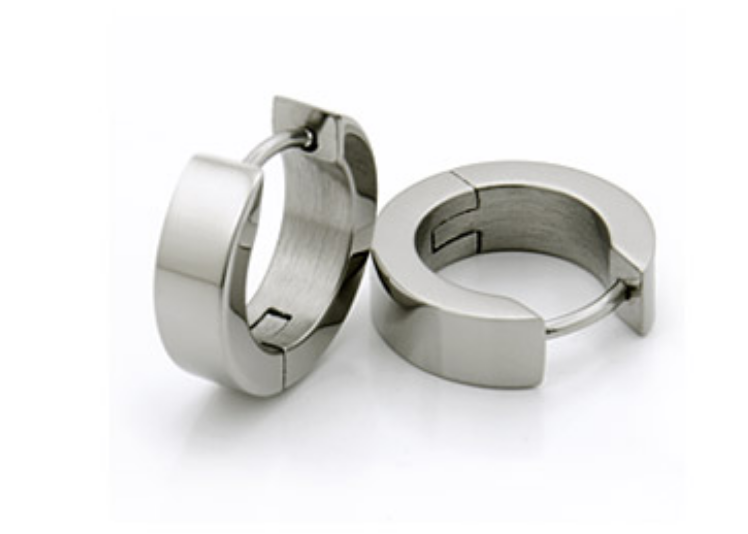
Titanium Style’s Hinged Hoop Earrings
At Avant-Garde Titanium Style, we don’t think beauty needs to be a pain. Our hinged hoop earrings are made from pure, medical-grade titanium that is nickel-free, cobalt-free, and 100% hypoallergenic. The hinged closure makes them easy to put in and take out, and the lightweight titanium design means you can wear them all day without earlobe fatigue.
Available in narrow or wide profiles, single or as a matching pair, our hinged hoops fit everyday wear, work, the gym, and most things in between. Safe for new piercings and sensitive skin, with the same warranty that covers the rest of our catalog.
How to Tell If Your Earrings Contain Nickel
Not sure what your current earrings are actually made of? There are a few reliable ways to find out.
The most accurate is a home nickel-detection kit. Kits cost under fifty dollars and show a color change when nickel is present. Rub the swab along the post and back of the earring. If it turns pink, red, or purple, the piece contains nickel and you should stop wearing it.
You can also ask the seller for a composition breakdown. A reputable jeweler can tell you whether a pair is solid titanium, plated steel, or a silver-alloy mix. If the seller cannot answer or hedges the answer, treat that as a no.
If you have a pair you love that contains nickel, you are not stuck. A jeweler can re-plate the piece with a barrier layer of rhodium or gold, which can buy you a few years of comfortable wear. Plating wears down with daily use, though, so for severe sensitivity the cleaner answer is swapping out for a pair that was never nickel-based to begin with.
Common “earring hacks” (clear nail polish, Vaseline, clip-on conversions) almost never hold up. Our earring hacks article breaks down why.
Frequently Asked Questions
What kind of earrings don’t make your ears itch?
+
What is the most hypoallergenic earring material?
+
Why are my ears suddenly rejecting my earrings?
+
Titanium vs. stainless steel for sensitive ears?
+
How do I stop my ears from being sensitive to earrings?
+
Find Hypoallergenic Earrings Your Ears Will Thank You For
We have spent decades making jewelry for people who shouldn’t have to choose between style and comfort. At Avant-Garde Titanium Style, every pair of earrings we make is pure titanium — nickel-free, cobalt-free, feather-light, and backed by the warranty that covers the rest of our catalog. We don’t plate. We don’t coat. We don’t call something hypoallergenic when the metal underneath is anything but.
Explore our titanium earrings collection to find a pair you can put in tomorrow morning and forget about by lunch. Your ears will thank you.
Shop Hinged Hoop Earrings! By clicking the link
1-513-520-0527
sales@titaniumstyle.com
