

Summary
Black wedding rings have a sleek, modern look, but how well they hold up depends on how that black finish is made. Some styles rely on coatings or plating that can scratch, fade, or show lighter metal underneath, while others, like black zirconium, stay dark because the material itself has been transformed.
Summarize full blog with:
You love the look of black wedding rings for a reason. They feel modern, a little unexpected, and they work with everything from “wedding-day perfect” to “I threw this on and ran out the door.” But style is only part of the equation.
If you are considering a dark band, you also want to know what happens after months of wear and tear. Will it scratch the first time you grab your keys? What about fading? Will it start flashing a lighter metal underneath?
It does not matter if a ring is high-end, handcrafted, or budget-friendly. If the black color comes from a surface coating, the ring will show wear at some point. The question is not if. It is how soon?
So before you fall for a product name or a pretty photo, it helps to know what actually makes a ring black and what that choice means once you are wearing it every day.
How Black Wedding Rings Are Made Black
Almost every black wedding ring you see falls into one of three groups. They can look similar in the box, but they hold up very differently once you wear them every day.
Surface Coating or Plating
This includes PVD on titanium, black rhodium over gold, and other thin layers applied on top of a lighter metal. The ring starts as gray or white. The black is sprayed, plated, or deposited onto the surface. That layer is always thinner than the metal underneath, which is why wear shows as soon as that top layer starts to break down.
Anodizing and Similar Treatments
Some stainless steel and titanium finishes use anodizing or related processes. These treatments change the surface color by altering the oxide layer, but the change is still shallow. It behaves like a controlled surface treatment and will show wear in high-contact spots over time.
What “Material Transformation” Actually Means
Material transformation is when the metal’s surface changes at a structural level. The black color is not added on top. It forms because heat or pressure alters the outer layer of the metal itself. The result is a dark, hardened surface that becomes part of the ring rather than a coating sitting above it.
With material transformation, the black color does not peel, wear away, or reveal lighter metal in normal wear. The surface can still show marks over time, but those marks do not expose a different color. The ring stays black because the material itself has turned black.
Will a Black Wedding Ring Fade Over Time?
A black wedding ring can fade over time, but that is not random. It is almost always the result of how the black color was created in the first place. Once you know whether your ring relies on a coating, an anodized surface, or a material transformation, you can set realistic expectations.
If the ring gets its color from a coating or anodizing, fading is part of the deal. The dark layer is thin and sits on top of a lighter metal. Daily wear is enough to slowly break it down. You may not notice it right away, but over months and years, you start to see changes:
- Edges lose some depth and look lighter.
- Tiny scratches show the base metal underneath.
- The palm side of the ring turns a bit two-tone.
You can refinish or re-coat a ring like that, and some people do, but it becomes a maintenance choice. You are signing up for a finish that needs to be renewed from time to time if you want it to stay fully black.
With material transformation, the surface can still show marks over time, but those marks do not expose a different color. The ring stays black because the material itself is black.
Do Black Wedding Rings Scratch Easily?
Some do. Some do not. It depends almost entirely on the material.
Daily wear exposes every ring to friction: keys, desk edges, gym equipment, tools, and hard surfaces. With coated rings, contact wears through the thin surface layer. The scratch may not be deep, but the contrast between dark coating and light metal makes it stand out.
Here is how the most common black wedding ring materials behave.
Black Titanium Rings
Black titanium starts as light gray titanium. The dark look comes from a surface layer, usually something like black rhodium or a similar coating. You still get that easy, comfortable feel titanium is known for, but the black is only skin-deep. When the surface wears, the silver-gray underneath starts to show.
Pros:
- Very lightweight and easy to wear all day
- Lower price point than many black metal options
- Base titanium is generally kind to sensitive skin.
Cons:
- Black coating can chip or scuff and show bright titanium.
- Finish can look patchy or two-tone with heavy wear.
- The coated surface itself is not hypoallergenic.
Black Stainless Steel Rings
Black stainless steel starts as standard stainless steel. The color comes from anodizing, which alters the surface layer to look dark and sleek while the core metal stays the same. It gives you an affordable way to try a black band, but the finish is still on the softer side.
Pros:
- A very budget-friendly way to wear a black wedding ring
- Easy to find in many basic styles
- Good for testing if a black band feels right for you
Cons:
- Scratches and scuffs show up quickly.
- Not the best match for sensitive skin
- The finish can look worn sooner with daily use.
Black Zirconium Rings
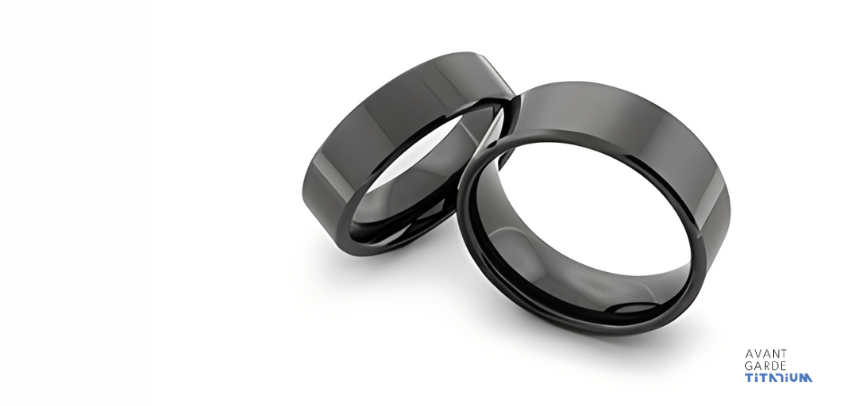
Black zirconium starts as gray metal. Under very high heat, the surface changes into a black ceramic-like layer that bonds to the metal. It is a material transformation, not a simple coating. You get a deep, stable black surface built to handle daily wear.
Pros:
- Strong surface that resists scratching in day-to-day use
- Black finish does not fade or tarnish.
- Lightweight and comfortable on the hand
- Hypoallergenic, good for sensitive skin
Cons:
- Not as widely stocked as some other materials.
- Resizing options are limited or unavailable.
Black Tungsten Rings
Black tungsten begins as very hard tungsten carbide. The dark color comes from a layer of tiny black particles bonded to the surface. The core stays its usual gray tone. You get a dense, weighty ring with a bold presence, but the black layer is still a finish on top.
Pros:
- Very hard core that resists bending
- Strong, substantial weight that some people prefer
- Good scratch resistance on the base tungsten
Cons:
- The black surface layer can scratch and show lighter tungsten.
- May cause reactions if cobalt or certain binders are used
- Difficult or impossible to resize
Black Gold Rings
Black gold is usually white gold plated with black rhodium. The gold underneath is still a precious metal, but all of the color you see comes from that thin plated layer. It gives a glossy, high-end look while the plating is fresh, but it demands more upkeep than most people expect.
Pros:
- Can be re-plated to restore a deep black finish
- Has the familiar weight and feel of gold
- Works well in detailed fine jewelry designs
Cons:
- Plating can chip, scratch, and thin over time.
- Needs regular re-plating to stay fully black
- Possible irritation if the white gold underlayer contains nickel
Solid Black Diamond (Elysium) Rings
Elysium rings are made from compressed lab-grown diamond crystals, fused into a solid black diamond structure. The color runs through the entire piece. There is no surface layer to rub away. You get the highest level of scratch resistance available, with a price and rigidity to match.
Pros:
- Extremely scratch-resistant, at the top of the hardness scale
- Solid black throughout, so the color does not change
- Lightweight and hypoallergenic
- Built to handle heavy wear without losing its appearance
Cons:
- Among the most expensive options
- Cannot be resized once made
- Limited availability and fewer jewelers who work with it
Are Black Wedding Rings Good for Everyday Wear?
Black wedding rings can work very well for everyday wear if you match the material to your habits.
If you work with your hands, lift often, or know your ring will hit tools, weights, or rough surfaces, the construction starts to matter more. Material-based blacks, such as black zirconium or black ceramic, handle that kind of wear better than thin surface finishes. They still show life over time, but you are less likely to see bright metal breaking through the color.
No matter which path you take, black wedding rings come with a few shared tradeoffs:
- Many cannot be resized once they are made.
- Repairs are more limited than with softer metals.
- Emergency removal can require cracking harder materials instead of bending them.
That is not a dealbreaker. It just means sizing and fit matter more from the start. A comfort-fit interior and accurate sizing give you a ring that feels good day after day and is less tempting to take off when you are busy.
Why Avant-Garde Titanium Style Recommends Black Zirconium Ceramic
At Avant-Garde Titanium Style, everything we make starts with one principle: integrity. No coatings. No shortcuts. Only materials that can stand up to years of wear without losing their shape or color.
We specialize in premium titanium and black zirconium ceramic rings that are crafted with care, precision, and purpose. Every ring is hand-finished for comfort and durability. The goal is simple. Your ring should feel effortless on your hand and hold its look through years of daily wear.
That is why we do not offer black titanium coatings. We have seen how quickly surface finishes can scratch and fade, and we believe your ring deserves better. Black zirconium ceramic gives you a deep, rich black created through material transformation, not paint or plating. The surface becomes ceramic and stays that way, so you get bold color without constant worry about wear.
Ready to choose a black wedding ring that does not just look good, but stays that way?
Explore our collection of black zirconium ceramic at Avant-Garde Titanium Style, crafted for longevity and finished for life.

Leave A Comment
You must be logged in to post a comment.